
In the comic book adaptation generation that we live in, I will not claim, like many people have, to be a “closet comic book reader”. I take each comic book adaptation as a film text and enjoy it, or not as the case may be, as a film text.
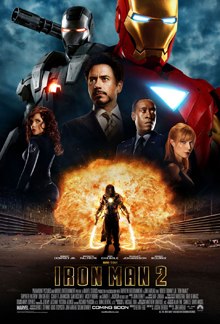 Iron Man (2008, Dir. Jon Favreau) was the origin story of Tony Stark’s Iron Man suit, and it was the first film fully financed by Marvel Studios. Just like its protagonist, Iron Man was eccentric, confident and very enjoyable to watch. It had a fantastic special effects and for the comic book novice explained the origin (as origin stories should) of Iron Man very clearly. The problem with being in the comic book adaptation generation, is that this genre is constantly evolving, from the original Batman (1966, Dir. Leslie H. Martinson) to Blade (1998, Dir. Stephen Norrington) all the way to Kick-Ass (2010, Dir. Matthew Vaughn). This evolution will surely culminate into a film that brings many Marvel characters together in the fight for justice. The Iron Man franchise fits into this evolution with implied futures shown after the credits. It is this idea that brings me onto Iron Man 2 (2010, Dir. Jon Favreau).
Unlike its prequel, the origin story, Iron Man 2 does not have a definitive beginning, but simply carries on where it left off, with Tony Stark’s ‘Arc Reactor’ slowly poisoning him meaning another arc reactor is needed. However, like its prequel, Iron Man 2 has a post credits scene implying the next step in the evolution of the genre. With no real beginning, and no real end, Iron Man 2 simply feels like a stepping stone, two hours that, despite being entertaining, is not necessary in the future of comic book adaptations.
Despite this disappointing fact, if it was meant simply as entertainment, it succeeded.Iron Man 2 was full of enjoyable performances, Don Cheadle stepped into Terence Howard’s boots seamlessly and played off Robert Downey Jr. well, with the implication of a long-time, if not rocky, friendship being thoroughly believable. Robert Downey Jr. did not disappoint with a performance that the audience doesn’t want to stop watching. Sam Rockwell does what he does best, playing the sort of bad guy people love to hate. Mickey Rourke is an enigma, his Russian accent needs work, however with his physical acting and his tattooed body, the accent can be overlooked. While it would appear strange to have the Russians as a real threat to the Americans, it must be pointed out the original Iron Man comics were created in 1963, in the heart of the cold war.
The film also has many unnecessary stunts and explosive effects, but that is also part of its charm and the special effects of the Iron Man suit in action is nothing sort of spectacular, unlike Spider-Man (2002, Dir. Sam Raimi) which relied solely on CGI for the scenes in-which Spiderman is in action, with the Iron Man suit in action it appears to be a cross between CGI and real action, making the visuals far more believable.
The narrative follows Tony Stark as his sinks into depression, knowing the his arc reactor will not be able to prolong his life expectancy and that his death is impending, this depression is also brought on by the creation other proto-type suits by Mickey Rourke’s character, Ivan Vanko, and Sam Rockwell’s character, Justin Hammer. These prototypes mean that the creation of the suit has not stopped nuclear war, but just enhanced the battle fields of the future, a realisation that came to the creator of dynamite, Alfred Nobel, although it was not nuclear war he was intending to stop, but general warfare. It is this similarity that brings unites Iron Man 2 with reality. There is also a clear message as the film continues that technology is not the sole future, but that man is always going to be necessary to control this technology. A refreshing message as technology is constantly expanding and growing stronger. This message will become clear, not at any point in particular, but continually as the film progresses.
I do not feel that by explaining that there a ‘boss battle’ at the film’s close, that I am giving anything away, this is expected in almost any comic book adaptation. The final battle in this film is unfortunately dispiriting to say the least. It draws so many parallels with the final fight of its prequel that there is little excitement in it, but just a predictable course of events.
Despite Iron Man 2’s flaws, it is worth the watch and is two hours of unadulterated adrenaline-pumping, action-packed entertainment with thoroughly talented performances and impressive stunts and special effects. With a clearer structure, the beginning, middle and end, that any story really needs, it would have appeared better, but as an installment of a generation of comic book adaptations it fits in. The future of comic book films is in sight and it will be interesting to see where Marvel takes us next.
Written by Edward L. Corrigan on 29/04/2010

