Thursday, 10 November 2011

The Girl who Played with Fire


The second installment of Stieg Larsson’s Millennium trilogy has hit the big screens. After the The Girl with the Dragon Tattoo brought such high hopes for this Swedish trilogy, The Girl who Played with Fire (Flickan som lekte med elden) failed to live up to the high expectations. The amount of fans of the books keeps growing, so this film not only had to contend with the reputation of it’s prequel, but with the reputation of the book. It has been said that all trilogies have to have a weak installment, and it can only be hoped that this is the only weak spot with the release of The Girl who Kicked the Hornet’s Nest fast approaching.
 
The stories of Lisbeth Salander and Mikael Blomkvist continue as Salander is accused of triple homicide and Blomkvist tries to prove her innocence while investigating a sex trafficking ring.  

The Girl who Played with Fire’s character development was anaemic and lack-luster. A year has passed since the previous film and no exposition is provided. Relationships between the journalists aren’t explained, which is hard enough to understand without having read the books, but on Lisbeth’s return to Sweden she tries to reconnect with old friends, but again there is no exposition to these friends, and despite their obvious integral roles in the story-line they all seem to have cameos and bit parts, brushed to the side. The police’s investigation of Salander is also incredibly loose and unprofessional, we as an audience can’t feel any connection to them, despite their jobs being vital to both the story, the Swedish society and to understanding Salander’s mysterious background. This is disappointing because the mystery and intrigue surrounding Salander was so well set-up in the first film. Despite the poor character development, it has to be understood. The film runs for over two hours and to accurately explain everything necessary, the film would run for over three hours, which would have lost a lot of audience members, with many not being willing to watch a subtitled feature anyway. This causes problems however, because the final installment is a longer book. Time will only tell if Oplev’s successor, Daniel Alfredson can rescue what started as a magnificent trilogy from the brink of failure.

This story is also missing a characteristic that helped make The Girl with the Dragon Tattoo what it was. The relationship between Blomkvist and Salander. It was always a strange relationship, but due to distance and secrecy, the relationship should have become far more interesting, but it was placed on the back-burner in order to keep the story going. This film felt less like a work of art and more like a story, which was another disappointment. The original complex story had many of the complexities removed, it seemed like plot device after plot device, driving the narrative forward. The original reason for Blomkvist’s investigation, and Salander’s past being brought to the public eye was Millenium’s work on a sex trafficking scandal, which as time passed seemed to be put to the side and slowly slipped from the story all together. 

Despite all of these problems, the film had a beautiful aesthetic. A stark contrast between the opening in the Caribbean to the cold dark streets of Sweden shows how two worlds can collide, the dark and private world of Salander, and the open and world of Blomkvist. The shots of flames engulfing buildings and people representing Salander’s explosive nature. The imagery continues to impress even though the story fails to. 

While this film fails to live up to the reputation that The Girl with the Dragon Tattoocreated, there is still time to recreate the greatness of Larsson’s novels. The final installment is to be released soon, and Hollywood have got their grubby hands on the rights. This however might not be as bad a situation as it sounds. With Daniel Craig set to take the role of Blomkvist, there is a chance that Craig’s charisma will bring out the womanising Blomkvist who is not afraid to take practical matters into his own hands, that Larsson created, and not the Blomkvist that we see on the Swedish big screens.


Written by Edward L. Corrigan 10/10/2010

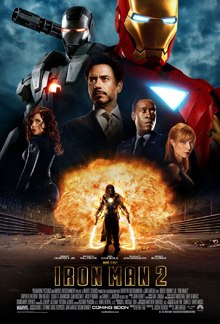
Iron Man 2 (2010)


In the comic book adaptation generation that we live in, I will not claim, like many people have, to be a “closet comic book reader”. I take each comic book adaptation as a film text and enjoy it, or not as the case may be, as a film text.
 Iron Man (2008, Dir. Jon Favreau) was the origin story of Tony Stark’s Iron Man suit, and it was the first film fully financed by Marvel Studios. Just like its protagonist, Iron Man was eccentric, confident and very enjoyable to watch. It had a fantastic special effects and for the comic book novice explained the origin (as origin stories should) of Iron Man very clearly. The problem with being in the comic book adaptation generation, is that this genre is constantly evolving, from the original Batman (1966, Dir. Leslie H. Martinson) to Blade (1998, Dir. Stephen Norrington) all the way to Kick-Ass (2010, Dir. Matthew Vaughn). This evolution will surely culminate into a film that brings many Marvel characters together in the fight for justice. The Iron Man franchise fits into this evolution with implied futures shown after the credits. It is this idea that brings me onto Iron Man 2 (2010, Dir. Jon Favreau).

Unlike its prequel, the origin story, Iron Man 2 does not have a definitive beginning, but simply carries on where it left off, with Tony Stark’s ‘Arc Reactor’ slowly poisoning him meaning another arc reactor is needed. However, like its prequel, Iron Man 2 has a post credits scene implying the next step in the evolution of the genre. With no real beginning, and no real end, Iron Man 2 simply feels like a stepping stone, two hours that, despite being entertaining, is not necessary in the future of comic book adaptations. 
Despite this disappointing fact, if it was meant simply as entertainment, it succeeded.Iron Man 2 was full of enjoyable performances, Don Cheadle stepped into Terence Howard’s boots seamlessly and played off Robert Downey Jr. well, with the implication of a long-time, if not rocky, friendship being thoroughly believable. Robert Downey Jr. did not disappoint with a performance that the audience doesn’t want to stop watching. Sam Rockwell does what he does best, playing the sort of bad guy people love to hate. Mickey Rourke is an enigma, his Russian accent needs work, however with his physical acting and his tattooed body, the accent can be overlooked. While it would appear strange to have the Russians as a real threat to the Americans, it must be pointed out the original Iron Man comics were created in 1963, in the heart of the cold war.
The film also has many unnecessary stunts and explosive effects, but that is also part of its charm and the special effects of the Iron Man suit in action is nothing sort of spectacular, unlike Spider-Man (2002, Dir. Sam Raimi) which relied solely on CGI for the scenes in-which Spiderman is in action, with the Iron Man suit in action it appears to be a cross between CGI and real action, making the visuals far more believable. 

The narrative follows Tony Stark as his sinks into depression, knowing the his arc reactor will not be able to prolong his life expectancy and that his death is impending, this depression is also brought on by the creation other proto-type suits by Mickey Rourke’s character, Ivan Vanko, and Sam Rockwell’s character, Justin Hammer. These prototypes mean that the creation of the suit has not stopped nuclear war, but just enhanced the battle fields of the future, a realisation that came to the creator of dynamite, Alfred Nobel, although it was not nuclear war he was intending to stop, but general warfare. It is this similarity that brings unites Iron Man 2 with reality. There is also a clear message as the film continues that technology is not the sole future, but that man is always going to be necessary to control this technology. A refreshing message as technology is constantly expanding and growing stronger. This message will become clear, not at any point in particular, but continually as the film progresses.
I do not feel that by explaining that there a ‘boss battle’ at the film’s close, that I am giving anything away, this is expected in almost any comic book adaptation. The final battle in this film is unfortunately dispiriting to say the least. It draws so many parallels with the final fight of its prequel that there is little excitement in it, but just a predictable course of events.

Despite Iron Man 2’s flaws, it is worth the watch and is two hours of unadulterated adrenaline-pumping, action-packed entertainment with thoroughly talented performances and impressive stunts and special effects. With a clearer structure, the beginning, middle and end, that any story really needs, it would have appeared better, but as an installment of a generation of comic book adaptations it fits in. The future of comic book films is in sight and it will be interesting to see where Marvel takes us next.
Written by Edward L. Corrigan on 29/04/2010

The Girl with the Dragon Tattoo (2010)


Having not read the original book The Girl with the Dragon Tattoo (literally translated to Män som hatar kvinnor – “Men Who Hate Women”) by Stieg Larsson, this is not a comparison or an analysis of the adaptation, but as a review of the film as a stand alone text.
One of the great things this film has done, is bring foreign language films to the mainstream population. The Girl with the Dragon Tattoo is currently being shown at most of the main multiplexes. Just as Tarantino did with Inglorious Basterds, Niels Arden Oplev has done, he makes the audience look past the language barrier and accept the film for what it is.
The year is 2006 and an investigative journalist, Mikael Blomkvist is hired to find the killer of a sixteen year old girl who disappeared 40 years ago. When he hits a wall, a computer hacker who has been following his progress after she researched him for a client, finds a lead he has overlooked. This sounds like a weak plot from a classic ‘made-for-TV’ murder mystery, but Oplev creates mystery and suspense from the opening shot. A film that lasts two and a half hours generally has certain low points that are less engaging for the audience, this is something that The Girl with the Dragon Tattoo is missing. It mixes action, suspense and mystery so that the audience is unable to switch off. 
The mystery in the plot is not the narrative itself, it is not the search for the killer, and this is where The Girl with the Dragon Tattoo steps clear of the other murder mystery programmes and films, the mystery lies within the character of Lisbeth, the girl with the dragon tattoo. There are constant implied hints about her backstory, but they are never fully revealed. She also has many personality traits that in general life have a backstory. Her sadistic guardian tells her that if she does not do as he says she will find herself back in a psychiatric ward, she has a constant fear of commitment, and a problem with authority, in particular the police. The hints into her background continue throughout the film, but are never fully explained, which is to the film’s credit. The narrative concludes, but the character’s personal lives do not. As the film was based on a book, and the book was part of a trilogy, the unanswered questions about Lisbeth will draw in the audiences to the second and third installments. Due to the trilogy aspect, The Girl with the Dragon Tattoo can do spend more time on character development. Character development is the advantage that T.V dramas have had over feature films for some time, this film is showing potentially, incredibly in-depth character development.
The film also turns the patriarchal film society upside down. Despite there being a male protagonist, it is the female protagonist the audience is drawn to, due to the intrigue into her origins, she is also the stronger of the two characters. When Blomkvist does not know how to carry on his investigation, it is Lisbeth’s intelligence that brings them together, when he is in trouble, she is the character with more courage to stand up and save him. It is not a feminist text in the traditional definition of the term, as the male characters are often more dominant, or are more important on the hierarchal scale, but Lisbeth is the light at the end of the tunnel for downtrodden and mistreated women, showing that it is possible to fight back against male oppressors, something she does with great style. The fact that she is needed, makes her all the more powerful. The gothic look that she maintains should be to her detriment, but her intelligence overlooks her image and her gender.
At the beginning of the film, it is debatable whether or not the Swedish backdrop is necessary, or if it could be adapted to be set anywhere. But while looking into the history of the missing girl and her family’s affiliation with the Nazi Party in the 1930s it became clear that the film had to be set in central Europe and the natural Swedish mountains and lakes makes for a picturesque backdrop that is a high contrast to Lisbeth’s almost unnatural appearance due to her tattoos and piercings. Each location was clearly picked out meticulously and by the end, the location was almost as important to the narrative as the characters.
Despite having a predictable structure, The Girl with the Dragon Tattoo made a lasting impression and the two following installments are awaited eagerly.
Written by Edward L. Corrigan 19/04/2010